
In brief
Tirzepatide is a 39-amino-acid peptide based on the GIP sequence that acts on both the GIP and GLP-1 receptors. The FDA licensed it as Mounjaro in 2022 and as Zepbound in 2023.
nu.life products are research compounds for laboratory use. They are not Mounjaro or Zepbound, and they are not medicines.
At a glance
- Status
- Approved medicine exists
- FDA record
- Mounjaro, NDA 215866, approved 13 May 2022. Zepbound, NDA 217806, approved 8 November 2023.
- Research code
- LY3298176
- Molecular weight
- 4813.53 Da
- Formula
- C225H348N48O68
Get it from nu.life
Same-day UAE delivery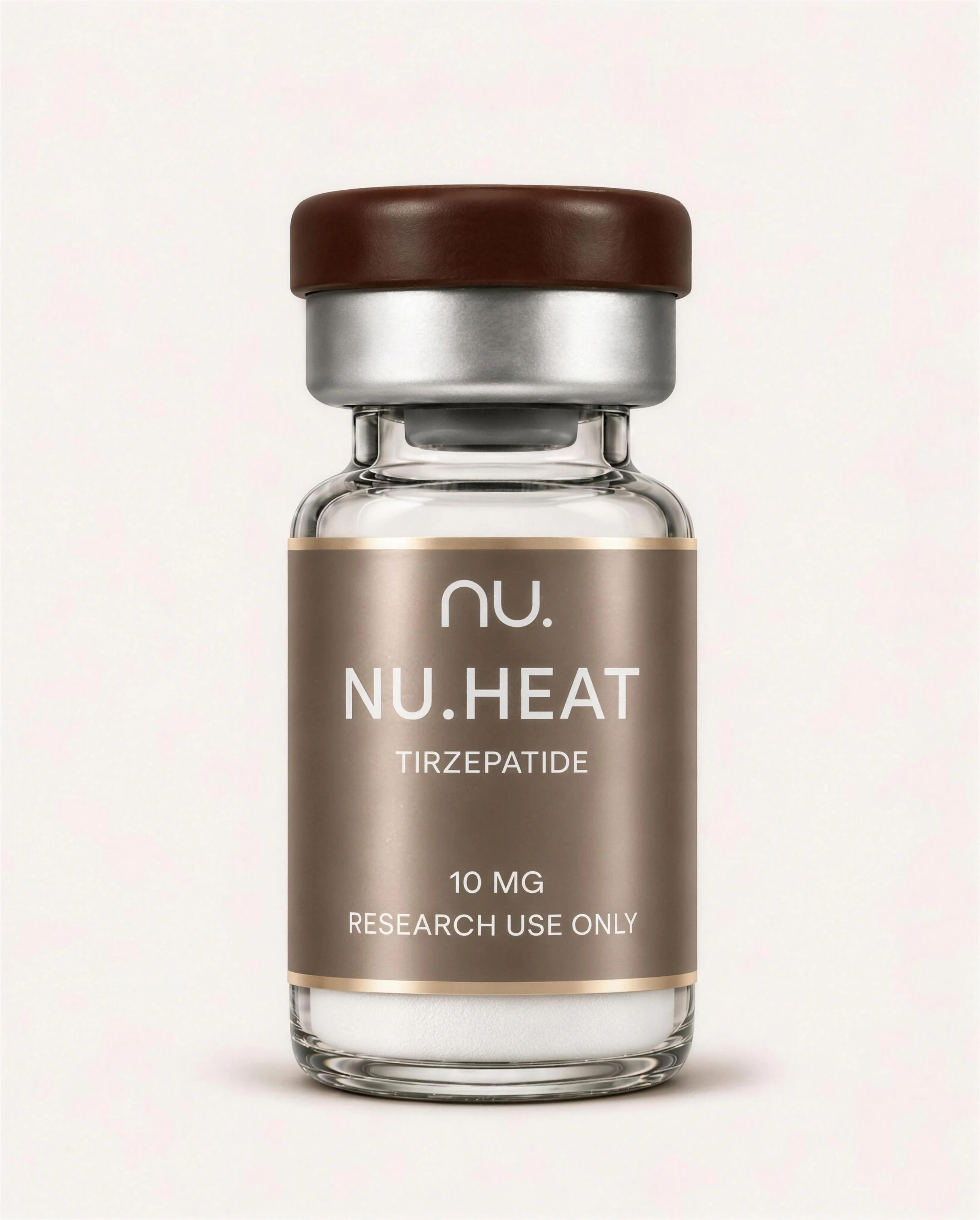

nu.life products are research compounds for laboratory use. They are not Mounjaro or Zepbound, and they are not medicines.
01
What is tirzepatide?
Tirzepatide is a synthetic peptide of 39 amino acids. The FDA label describes it as based on the sequence of GIP (glucose-dependent insulinotropic polypeptide), built to act on two receptors rather than one.
Three positions differ from a plain chain, and they are the brass pearls on the strand above: an Aib residue at positions 2 and 13, and the lysine at position 20, which carries a C20 fatty diacid (1,20-eicosanedioic acid) through a linker. The chain ends in an amide.
02
How it acts
The FDA label describes tirzepatide as an agonist at both the GIP receptor and the GLP-1 receptor: one molecule that switches on two receptors.
It was first described under the research code LY3298176 by Coskun and colleagues in Molecular Metabolism in 2018.
03
Regulatory status
The FDA approved tirzepatide as Mounjaro on 13 May 2022 (NDA 215866) and as Zepbound on 8 November 2023 (NDA 217806). Both are prescription medicines.
Those approvals cover the branded medicines only. A research vial of the same compound is neither of them.
Sources
- 1.Drugs@FDA: Mounjaro (tirzepatide), NDA 215866
- 2.Drugs@FDA: Zepbound (tirzepatide), NDA 217806
- 3.Coskun T. et al. Molecular Metabolism, 2018 (PubMed 30473097)
Last reviewed: 26 November 2026. This guide is educational and is not medical advice. All products are intended for laboratory research purposes only and are not for human or animal consumption. They are not intended to diagnose, treat, cure, or prevent any disease.
